
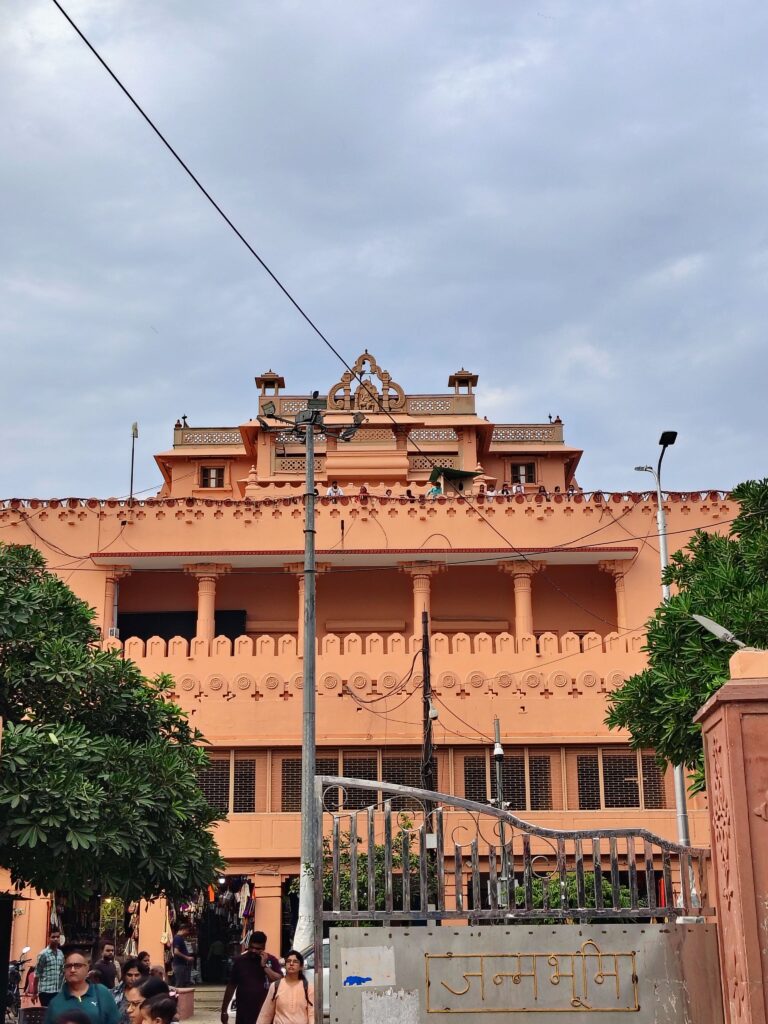
Janambhumi – The birth place of lord Krishna, Where mother and father of Shree Krishna was locked in jain by Kans (Brother of Krishna’s Mother) The Krishna Janmasthan, at Mathura, is important because this is where Lord Shri Krishna manifested Himself in the prison house of the cruel king Kansa and set free his father Vasudevaand his mother Devaki.Krishna Janmasthan Temple is a Hindu temple situated in Mathura, Uttar Pradesh, India. There are three main temples inside the premises — Keshavdev temple which is dedicated to Krishna, Garbh Griha where Krishna is believed to be born in Dvapar Yuga and Bhagvata Bhavan where presiding deities are Radha Krishna. According to Hindu traditions, Krishna was born to Devaki and Vasudeva in a prison cell where they were confined by his maternal uncle Kamsa, a king of Mathura, due to prophecy of his death by the child of Devaki.According to tradition, a temple dedicated to Krishna was built the birthplace by his great-grandson Vajranabh.In 1017 or 1018, Mahmud of Ghazni attacked and plundered Mahaban. He ordered to burn all the temples and demolish them. He plundered gold and silver statues and carried away a load of hundred camels.A stone inscription in Sanskrit found from the site mentions that in Vikram Samvat 1207 (1150) a person named Jajja who may have been a vassal of Gahadavala king built a Vishnu temple which was ‘brilliantly white and touching the clouds’.
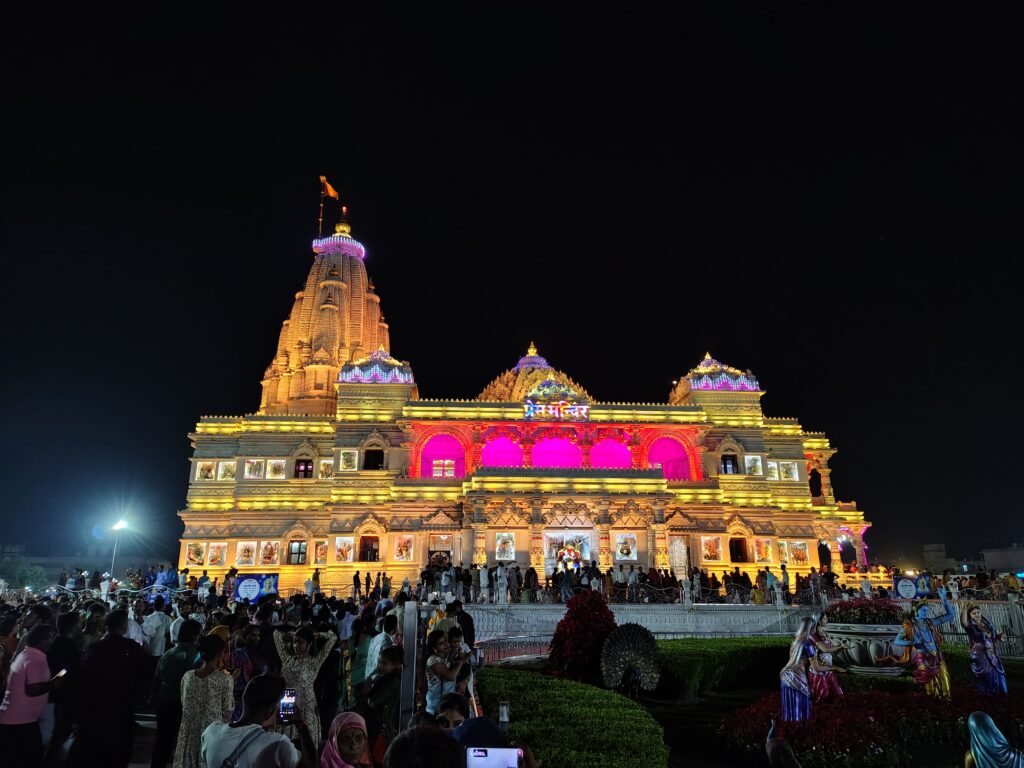
Prem Mandir – (lit. The Temple of Divine Love) is a Hindu temple in Vrindavan, Mathura district, Western Uttar Pradesh, India. The temple was established by Jagadguru Shri Kripalu Ji Maharaj.It is maintained by Jagadguru Kripalu Parishat, an international non-profit, educational, spiritual, charitable trust.The complex is spread across a 22-hectare (55-acre) site on the outskirts of Vrindavan. It is dedicated to Radha Krishna and Sita Ram. Radha Krishna are on the first level and Sita Ram are on the second level.The foundation stone was laid by Jagadguru Shri Kripalu Ji Maharaj in the presence of thousand devotees on 14 January 2001. The structure took around 12 years to construct, involving around 1000 artisans.Prem Mandir is constructed entirely of Italian marble. The total dimensions of the temple including its flag is 38 metres (125 ft) high, 58 metres (190 ft) long and the 39 metres (128 ft) wide raised platform serves as the seat of the two-storeyed white monument.The Vrindavan site was developed by Kripalu Ji Maharaj, whose main ashram was in Vrindavan. He dedicated the gift of divine love to Shri Vrindavan Dham.
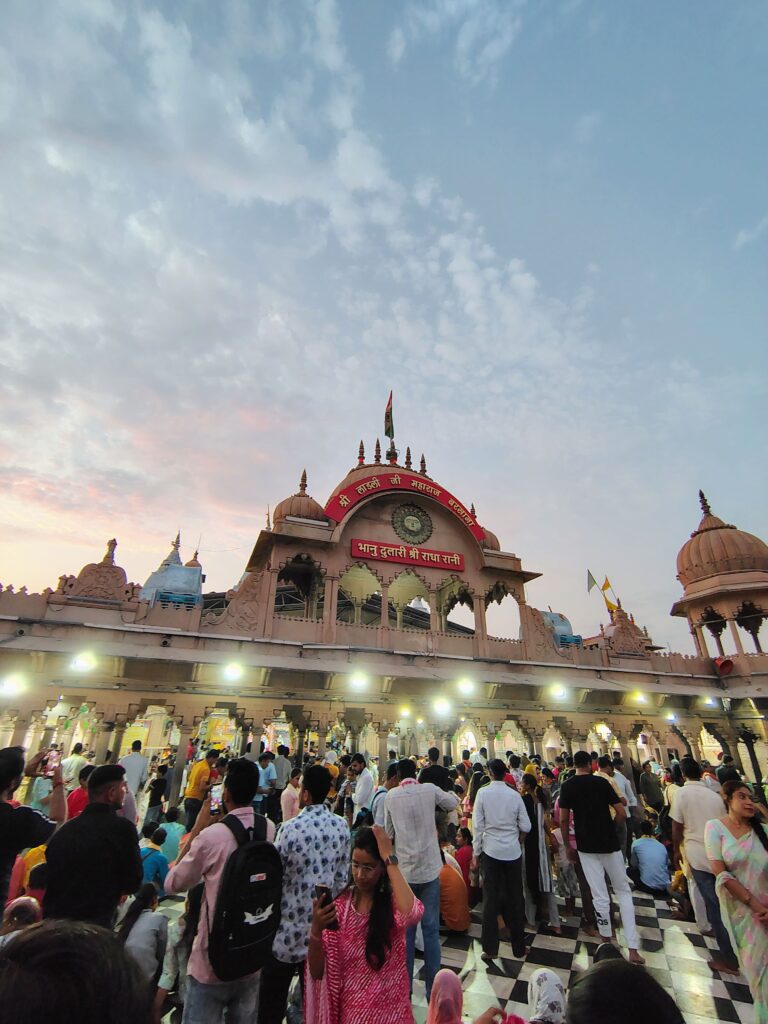
Shri Radha Rani Temple – is a historical Hindu temple, located in Barsana in Mathura district, Uttar Pradesh, India.The temple is dedicated to the goddess Radha. The main deities of the temple are Radha Krishna who are worshiped together in the form of Shri Laadli Lal, which means the beloved daughter and son of the town.Radha Rani Temple is originally believed to be established by King Vajranabh (great-grandson of Krishna) around 5000 years ago. The temple is said to be in ruins; the icons were rediscovered by Narayan Bhatt (a disciple of Chaitanya Mahaprabhu) and a temple was built in 1675 AD by Raja Bir Singh Deo. Later, the present structure of temple was built by Narayan Bhatt with the help of Raja Todarmal, one of the governors in the Akbar’s court.Shreeji Temple, with its arches, pillars and red sandstone, looks like a structure dating back to the Mughal era. This popular temple in Barsana is a classic example of the Rajput architecture prevailing during that time. Besides Radhastami and Janmashtami, Lathmar Holi is also one of the significant festivals of the temple. To celebrate Lathmar Holi, devotees and tourists visit the temple. The Holi in Barsana starts a week before the actual day of the festival and lasts till Rang Panchami.
Leave a Reply